

The global landscape of work has undergone a seismic shift, moving away from the rigid structures of traditional leasing toward a model defined by agility and responsiveness. In 2026, coworking space management is no longer a matter of simply providing a desk and high-speed internet. It has evolved into a complex discipline of dynamic workspace orchestration. This transition is driven by the integration of Artificial Intelligence and advanced Property Technology (PropTech), which together are redefining what ‘efficiency’ means for flexible workspace operators.
For operators such as Venture X India, the challenge is to balance high-end hospitality with rigorous operational discipline. Static office management—characterized by manual spreadsheets and reactive maintenance—cannot keep pace with the modern professional’s expectations. Today, AI-driven systems analyze millions of data points to predict member behavior, optimize energy consumption, and ensure that every square foot of real estate generates maximum value. This guide explores the technological pillars of the 2026 coworking environment and provides a roadmap for achieving superior Return on Investment (ROI) through automation.
The era of members walking into a space and hoping for an available desk is over. While digital booking systems have existed for years, they were historically plagued by inaccuracies and rigid scheduling. AI has transformed these systems from passive registries into active management tools.
One of the most persistent drains on coworking revenue is the ‘ghost booking’—a situation where a member reserves a desk or meeting room but fails to show up. This inventory is effectively locked, preventing other members from using it and resulting in lost revenue opportunities. In 2026, AI-powered platforms identify these booked-but-empty spaces in real-time. By integrating with Wi-Fi login data, motion sensors, and even computer vision, the management system can detect if a desk remains vacant 15 minutes after a reservation begins.
Automated release protocols then take over. The system sends a gentle push notification to the member, asking if they still require the space. If no response is received, the desk is automatically released back into the available inventory pool. At premium locations like Venture X India, this ensures that the physical environment always reflects actual demand, maximizing the utility of every workstation.
Beyond real-time management, AI utilizes historical data to anticipate surges in occupancy. Modern algorithms analyze patterns across days of the week, local events, and even weather conditions to forecast when a space will hit 90 percent capacity. For a community manager, this information is invaluable. If the data predicts a surge on Tuesday mornings, the system can automatically adjust staff levels, ensuring that front-desk support and cleaning crews are optimized for the crowd. This level of foresight prevents the ‘over-staffing’ trap while maintaining the high service standards expected in enterprise-grade coworking hubs.

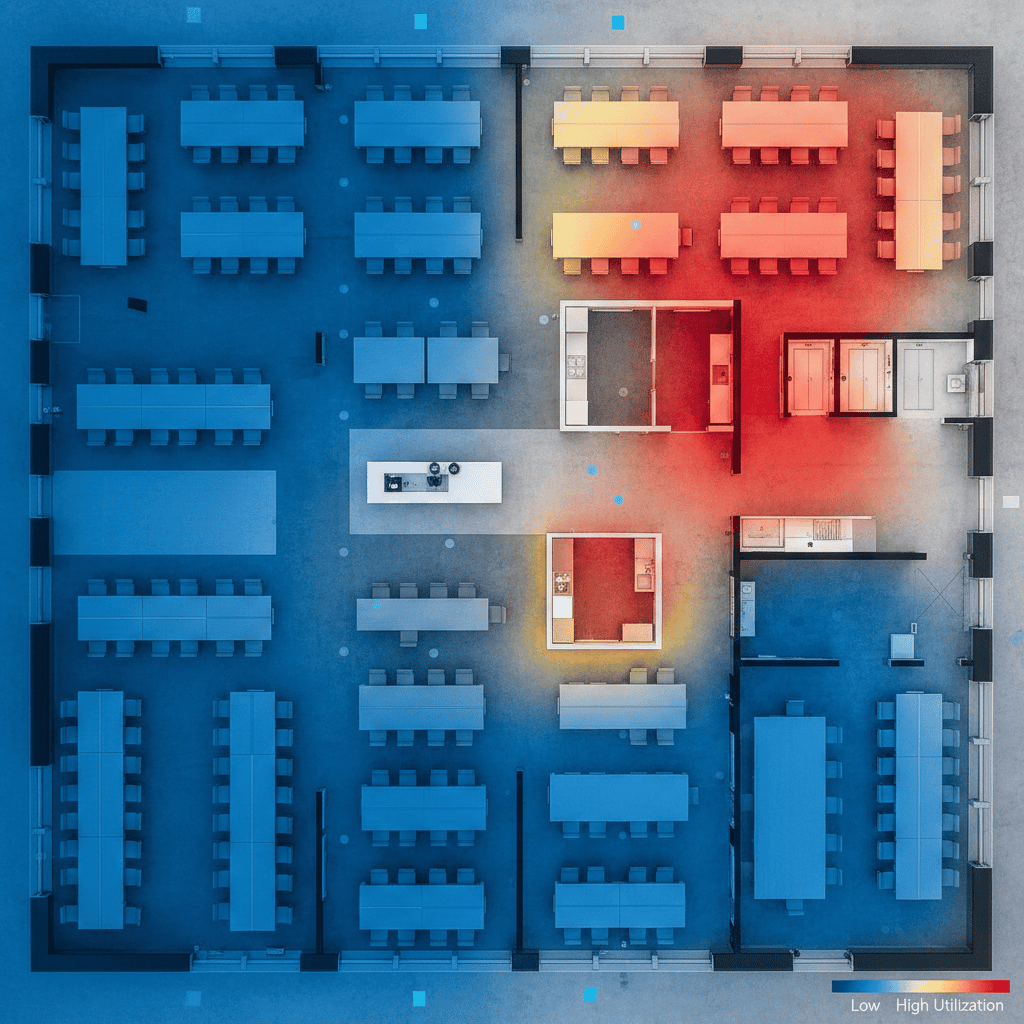
Occupancy analytics serve as the central nervous system of a smart coworking space. By understanding how members move and where they linger, operators can make data-driven decisions about floor plan layouts and resource allocation.
The hardware used to track occupancy has seen significant advancement. Traditional Passive Infrared (PIR) sensors, while cost-effective, often struggle with accuracy, sometimes failing to detect a member who is sitting still.
In 2026, many operators are turning to LiDAR (Light Detection and Ranging). LiDAR creates high-resolution 3D maps of a space using laser pulses. It is exceptionally accurate and does not require light to function. While the initial installation cost is higher than PIR, the depth of data provided—such as the exact distance between people and the precise path of foot traffic—allows for a much more nuanced understanding of space utilization. However, operators should note that LiDAR requires substantial processing power and backend infrastructure to manage the 3D point cloud data, which may present integration challenges for smaller operations seeking truly plug-and-play solutions.
Computer Vision (CV) offers another layer of intelligence. By processing video feeds through AI, CV can distinguish between a human, a laptop left on a desk, or a cleaning cart. This allows Venture X India and similar operators to differentiate between a ‘busy’ desk and a ‘cluttered’ one, leading to more efficient turnover.
As data collection becomes more granular, privacy concerns have moved to the forefront. In 2026, maintaining member trust is as important as the data itself. Smart spaces now implement anonymized data pipelines. This means that instead of tracking ‘Member A,’ the system tracks a ‘Unique User ID’ with no PII (Personally Identifiable Information) attached.
GDPR and CCPA compliance are built into the hardware level. Modern sensors often process data ‘at the edge,’ meaning the raw image or video never leaves the sensor. Only the numerical data—such as ‘Occupancy: 1’—is sent to the cloud. This approach not only protects privacy but also reduces latency and bandwidth requirements, making real-time analytics more responsive and cost-effective. This ensures that while the operator knows how many people are in the lounge, they are not infringing on individual privacy rights.
The ultimate goal of AI integration is to widen the margin between operational costs and membership revenue. Automation addresses the ‘hidden’ costs of running a large-scale facility.
Utility costs are typically the second-largest overhead for coworking spaces after rent. In a traditional office, the HVAC system runs on a timer, heating or cooling the entire floor regardless of occupancy. AI-driven PropTech changes this by integrating occupancy data directly with the Building Management System (BMS).
If a specific zone in a Venture X India facility is empty at 3:00 PM, the AI automatically dims the lights and adjusts the thermostat to an eco-mode. Conversely, if a meeting room is booked for ten people at 10:00 AM, the system pre-cools the room 15 minutes prior. This proactive climate control can reduce utility overhead by 15-30 percent depending on building age and existing infrastructure, directly impacting the bottom line.
Borrowing a page from the airline and hospitality industries, coworking operators are now using machine learning to implement dynamic pricing. In high-demand periods, the price of a day pass or a hot desk might increase slightly, while discounts are offered for off-peak hours (such as Friday afternoons). This helps smooth out the occupancy curve, preventing overcrowding on Tuesdays and Wednesdays while incentivizing usage during quieter times. AI models analyze competitor pricing, local demand, and historical trends to suggest the optimal price point in real-time.
The question for many operators is not ‘if’ they should implement AI, but ‘when.’ For boutique spaces, the break-even point might be reached through simple automated billing and basic PIR sensors. For enterprise-level operators like Venture X India, the ROI is found in the aggregate savings of large-scale energy management and the increased revenue from optimized desk turnover.
However, smaller operators should note that while AI has become more democratized, the break-even timeline for advanced hardware like LiDAR or Computer Vision can be longer due to higher upfront costs. Budget-conscious hubs may see faster returns by starting with basic PIR sensors and automated software before scaling to more sophisticated systems.
A useful framework for calculating ROI involves looking at three metrics:
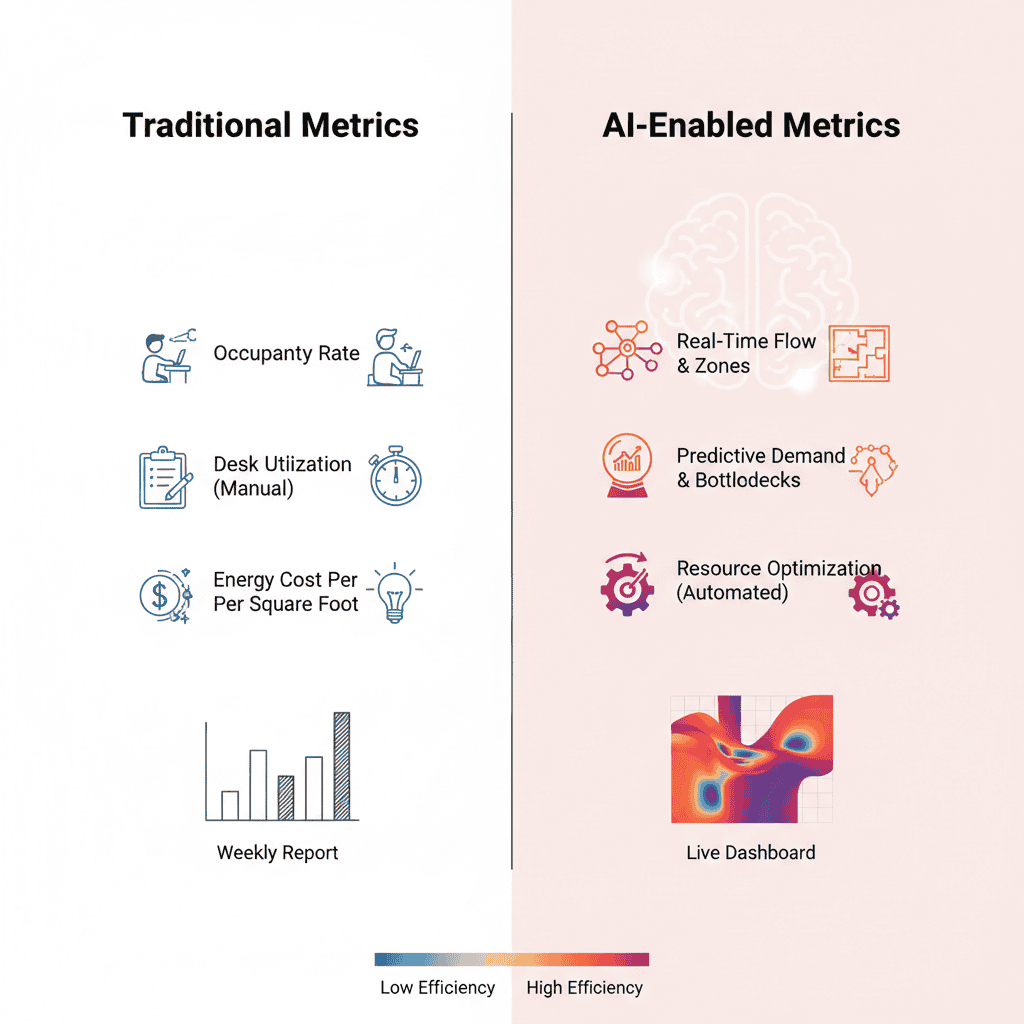
Comparison: Traditional vs. AI-Enabled Coworking Operations
Metric | Traditional Management | AI-Enabled Operations |
Desk Booking Accuracy | 60-70% (ghost bookings common) | 90-95% (real-time verification) |
Energy Cost per Sq. Ft. | Baseline | 15-30% reduction |
Admin Time on Member Inquiries | 15-20 hours/week | 3-5 hours/week (80% automated) |
Predictive Maintenance | Reactive (fix when broken) | Proactive (prevent failures) |
Member Networking Support | Manual introductions | AI-powered smart seating |

Efficiency is only one side of the coin; the other is the member experience. In 2026, AI acts as a digital concierge, making the workspace feel more intuitive and supportive.
One of the primary reasons professionals choose coworking is for the community. However, in a large space, it can be difficult to meet the right people. AI can bridge this gap by analyzing member profiles and suggesting seating based on professional synergy. If the system knows a member is a venture capitalist and another is a fintech founder, it might suggest they book desks in the same zone.
Furthermore, the system can learn individual preferences. If a member consistently chooses a quiet corner near a window, the AI will prioritize that location in future bookings, or suggest similar ‘quiet-zone’ desks if their favorite spot is taken. This level of personalization fosters a sense of belonging and increases member retention.
Community managers should be the heart of the space, focusing on hospitality and event curation. Too often, however, they are bogged down by billing inquiries, onboarding paperwork, and troubleshooting Wi-Fi. Generative AI and Large Language Models (LLMs) are now handling these administrative burdens.
Automated chatbots, trained on the specific policies of the space, can handle 80 percent of member inquiries instantly. Whether it’s a question about how to use the printer or a request to upgrade a membership plan, the AI provides immediate, accurate responses. This allows the onsite team at Venture X India to focus on high-value interactions that build community culture.
A common misconception is that AI-driven management is only for massive, multi-national chains. This is the ‘small space’ paradox: the belief that a boutique hub cannot afford the technology it needs to compete.
Scalable AI Solutions for Boutique Coworking Hubs
In 2026, the cost of AI has democratized. Small operators no longer need to build custom software or hire a massive IT department. Instead, they can leverage ‘plug-and-play’ SaaS platforms that offer AI features on a per-member or per-square-foot basis. By focusing on high-impact, low-cost automations—such as automated billing and simple occupancy sensors—single-location owners can achieve a level of professionalism and efficiency that rivals much larger competitors.
That said, boutique operators should set realistic expectations. While software-based AI tools are indeed affordable and accessible, advanced hardware solutions like LiDAR and Computer Vision systems carry higher upfront costs and require more complex integration. For smaller spaces, the break-even timeline may be extended, making it strategic to begin with cost-effective PIR sensors and cloud-based automation before graduating to more sophisticated tracking technologies.
Integration Ecosystems: Slack, Teams, and Existing CRMs
The key to a frictionless transition is integration. Members do not want to download another app. The most successful coworking AI implementations are those that live within the tools members already use. By integrating the desk booking and community platform with Slack or Microsoft Teams, operators ensure that the workspace remains a natural part of the member’s workflow. For example, a member can type ‘/book desk’ directly into Slack, and the AI backend handles the reservation and confirms the availability instantly.
As we look toward 2027, the trajectory of PropTech suggests even deeper integration between the physical and digital worlds. Several emerging technologies are moving from concept to early adoption, though their widespread deployment will depend on cost reduction, privacy acceptance, and proven ROI.
We are already seeing the early adoption of autonomous office robots. These units can handle routine cleaning, deliver mail to private suites, or even act as mobile telepresence units for remote team members.
Furthermore, biometric integration is expected to evolve beyond simple fingerprint scanners. Exploratory technologies such as palm vein scanning are being tested in select commercial facilities, while more speculative approaches like gait analysis remain in research phases due to significant privacy concerns and regulatory uncertainty. These systems aim to create a more frictionless office experience by eliminating the need for keycards or mobile apps for entry.
The data collected by these systems—if successfully deployed and adopted—will feed into even more advanced AI models, capable of predicting not just when a desk will be used, but potentially how environmental changes might affect workspace productivity. However, operators should approach these future-focused technologies with a clear understanding of the regulatory landscape and member expectations around privacy and consent.
The transformation of coworking space management in 2026 is driven by the realization that data is the most valuable asset an operator possesses. By moving from static management to AI-driven orchestration, spaces like Venture X India are setting a new standard for what a professional environment can be. The result is a workspace that is more than just a place to sit; it is a responsive, efficient, and personalized ecosystem that supports the success of its members while ensuring the long-term profitability of the operator.
Staying competitive in the rapidly evolving flexible office market requires a proactive approach to technology. Operators who embrace these tools today—starting with the most cost-effective and scalable solutions for their size and budget—will be the ones who define the future of work tomorrow.
Ready to modernize your workspace? Download our ‘2026 Smart Workspace Implementation Roadmap’ or schedule a demo of our AI Management Suite today to see how Venture X India is leading the future of flexible work.
Visit: venturexindia.com
AI boosts ROI by cutting operational waste and identifying new revenue streams. It slashes energy bills through smart HVAC control (15-30% depending on building infrastructure), recovers lost revenue by automatically releasing ‘ghost bookings,’ and uses predictive analytics to suggest dynamic pricing for desks during peak hours.
A ghost booking occurs when a member reserves a desk or meeting room but never shows up, locking out other paying users. AI solves this by using Wi-Fi data and motion sensors to detect empty seats. If a desk remains vacant 15 minutes past the start time, the system automatically releases it back into the available inventory.
Yes, LiDAR is superior for high-accuracy tracking. While traditional PIR sensors only detect basic motion and heat, LiDAR uses laser pulses to create a 3D map of the room. This allows it to detect a person sitting perfectly still and track precise foot traffic without the inaccuracies common in cheaper sensors. However, LiDAR requires substantial backend infrastructure to process 3D point clouds, which may present integration challenges for smaller operations.
AI integrates your booking schedule with the Building Management System (BMS) to optimize climate control. It automatically dims lights and adjusts the AC in empty zones while ‘pre-cooling’ meeting rooms 15 minutes before a scheduled session, reducing utility overhead by 15-30% depending on building age and existing infrastructure. Edge processing also reduces latency, making these adjustments more responsive and efficient.

Have questions? We’re here to help you find your perfect workspace at Venture X India. Drop us your details and we’ll get back to you shortly!